Break "Guitar Aficionado" magazine out in the NY Times, New York's "Grub Street" and others


A Guitar Magazine Tests the Luxury Waters

By STEPHANIE CLIFFORD


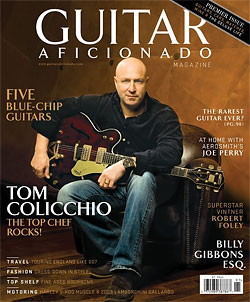
One might assume that the new magazine Guitar Aficionado is a spinoff of the 17-year-old Cigar Aficionado. Both have covers with celebrities holding the featured prop (the chef Tom Colicchio with a 1963 guitar, Jay-Z with a stogie of a presumably more recent vintage). men's fashion, and ads for cigars and speakers. Also, both titles include the word "aficionado."

But while Cigar Aficionado comes from M. Shanken, which also publishes Wine Spectator, Guitar Aficionado is from a more rocking family of magazines. It sprang from Guitar World, part of the magazine company Future US; that magazine, in its June issue, includes the music and lyrics for AC/DC’s “Thunderstruck” and Cannibal Corpse’s “A Cauldron of Hate.”

Greg Di Benedetto, the publisher of both guitar magazines, said Guitar Aficionado was aimed not at young hard-rock fans, but buyers of $6,000 guitars who would also buy expensive liquor, cars and watches.

Along with coverage of guitars, it includes stories on Aston Martin automobiles and the West Hollywood hotel Sunset Marquis (both are advertisers in the issue, which Mr. Di Benedetto said he did not see as a problem; it was “product placement,” he said.)

But the advertising picture for luxury magazines is bad. For instance, ad pages at American Express Publishing’s high-end magazine Departures fell 43 percent in the first quarter of the year, according to Publishers Information Bureau. And some magazines largely dependent on luxury ads have ceased operations recently, including Condé Nast Portfolio, Private Air and Trader Monthly.

Mr. Di Benedetto said that Guitar Aficionado’s schedule as a quarterly would help with ads. “It’s a completely different picture. Trader Monthly or Portfolio are victims of the times because it’s not really fashionable to tout the Wall Street trappings of success.”

Mr. Di Benedetto said the title’s similarity to Cigar Aficionado was not intentional.

“There was just no other way to describe it perfectly,” he said. “It’s got nothing to do with overlapping with any other magazine.”

“You can be an aficionado of many things, and the fact that it rhymes, I can’t help that,” he said.

++++


Tom Colicchio Wants to Show You His Fancy Guitars

Tom Colicchio Wants to Show You His Fancy Guitars

Photo: Courtesy of Guitar Aficionado

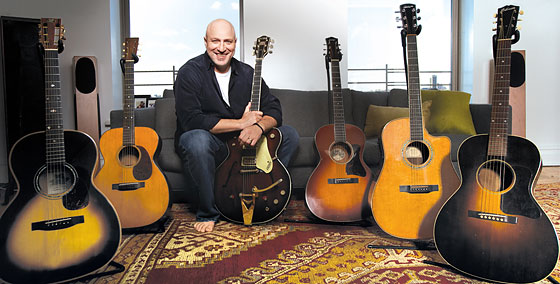
If you saw him rock out at last year’s Midnight Music and Munchies event at the New York City Wine & Food Festival, you know Tom Colicchio is a venerable axman. So how’d he master those Neil Young licks? Private lessons from Jefferson Airplane’s Jorma Kaukonen, according to an article in the premiere issue of Guitar Aficionado. The magazine is described as a glossy about rich baby-boomer celebs and their very expensive guitar collections — and none other than Don Colicchio, whose collection is valued at $45,000, is on the cover showing off a $5,000 Gretsch that’s identical to the one George Harrison played. Best part of the article, which unfortunately isn’t online (you’ll have to pick up a hard copy for Colicchio’s wine recommendations), is when Colicchio gets all Lloyd Betnsen about the matter of rock-star chefs: “Let me tell you — I know a few rock stars. I’ve been out with a few rock stars. And we are definitely not rock stars.” And now, below: Perhaps the greatest photo you will ever see.


OTHER HITS:

Huffington Post
Guitar News Daily
IHeartGuitarBlog

Guitar Edge
Revedia
Guitarbalooga

My concept for BrandIndex about Microsoft vs. Apple advertising turns into large Advertising Age story, then goes viral around web


In Mac vs. PC Battle, Microsoft Winning in Value Perception

View Has Shifted Dramatically Among Young Demo Since 'Laptop Hunters' Campaign


NEW YORK (AdAge.com) -- Apple may have some of the most interesting online ads we've seen in a while, but Microsoft's recent push to paint the competitor as pricey is starting to work, according to data from BrandIndex.

The perceptions of value the two brands offer has shifted dramatically in the eyes of 18- to 34-years-olds since Microsoft began running its "Laptop Hunters" campaign in late March. Apple's "value perception" has fallen considerably, while Microsoft's has risen.

The latest push documents several people hunting for a laptop, with the promise that if they can find everything they're looking for in a laptop for less than $1,000, the marketer will pay for the computer. The chosen ones shop both Windows-based PCs and Apple products before, naturally, finding what they need for the right price in a PC.

Based on daily interviews of 5,000 people, BrandIndex found the age group gave Apple its highest rating in late winter, when it notched a value score of 70 on a scale of -100 to 100 (a score of zero means that people are giving equal amounts of positive and negative feedback about a brand). But its score began to fall shortly after and, despite brief rallies, hovers around 12.4 today.

Microsoft, on the other hand, has risen from near zero in early February to a value-perception score of 46.2.

Cost-focused demo
To determine a brand's value score, BrandIndex asks consumers whether they believe they get a get good value for their money.

It's among young people that Microsoft's campaign is having the biggest and most sustained impact, said Ted Marzilli, global managing director for BrandIndex at consumer polling service YouGov. And that might have something to do with younger people tending to earn less money.

"Apple had a pretty big advantage, historically, when we look at our data," said Mr. Marzilli. "Apple did a great job of putting Microsoft on the defensive. It made them look old, stodgy, complicated to use and unhip. But Microsoft has started to hit back, and younger folks are more cost- or value-focused.

Among 35- to 49-year-olds, Microsoft saw a big jump around the second or third week of the campaign and momentarily overtook Apple; at the same time, Apple's "value perception" took a dip among this age group. Today, however, Apple is back on top. Among 50-plus consumers, the two brands are virtually neck and neck.

It's not just the economy that's shifting people's views of the two companies. As the data show, Apple led Microsoft in terms of value perception among the 18-to-34 crowd far after the financial crises really became hot and heavy in September 2008.

Strong campaign
"It would be very unusual for Microsoft's score to be increasing this much and Apple's to be decreasing without some sort of event driving that, like a major campaign that's particularly successful," said Mr. Marzilli.

"Laptop Hunters" is the latest execution of an estimated $300 million ad blitz from Crispin Porter & Bogusky that began last fall with humorous spots starring Jerry Seinfeld and Bill Gates.

Microsoft credited its ad campaign with helping it maintain strength in the consumer software market despite the recession. In a recent earnings call, it cited a 10% increase in preference to Windows PCs since the campaign launched.

++++

BRANDINDEX RESEARCH FOR MICROSOFT VS. APPLE AD CAMPAIGNS THEN APPEARS (WITH CHARTS) IN...

ZDNet
Wired News
CNET
Silicon Alley Insider
BNET
CrunchGear
DailyTech
Fast Company
AllThingsD (Wall Street Journal)
Technologizer
and many others....

Cramster is centerpiece of NY Times feature


May 18, 2009

Psst! Need the Answer to No. 7 on the Physics Exam? Click Here.


In the old days, college students might turn to classmates for help during all-night cram sessions before final exams. Now their study buddies are just as likely to be commercial Web sites with step-by-step solutions to textbook problems, copies of previous exams, reams of lecture notes, summaries of literary classics, and real-time help with physics, math and computer science problems.

“It’s a backup,” said Chris O’Connor, a pre-med sophomore at Columbia University who relies on a popular site, Cramster, to unravel the mysteries of complex math and science problems.

“Many professors who return homework won’t tell you how you got it wrong — just that it’s wrong. This way you can complete the feedback process, which is essential to learning.”

But as companies with playful names like Cramster, Course Hero, Koofers and SparkNotes are transforming the way undergraduates like Mr. O’Connor study, some professors and ethicists are questioning whether such Web sites encourage cheating and undermine the mental sweat equity of day-to-day learning by seducing students with ready-made solutions and essays.

On Course Hero, for example, students can type in a college name and course number to unearth the previous semester’s particle physics final exam. They can find examples of research papers on, say, the causes of World War I. For homework, Cramster supplies step-by-step solutions to problems in more than 200 college-level math and science textbooks.

“There are professors who don’t change their questions from semester to semester, and one of the things that this raises is how problematic that is,” said Teddi Fishman, director of the Center for Academic Integrity, which is part of the Rutland Institute for Ethics at Clemson University. “Part of what’s valuable about homework is that it gives you a safe space to practice and struggle.”

But defenders of the Web sites — including some professors — say that teachers should not be recycling exams and that students who simply copy homework solutions hurt themselves at exam time. Many of the documents posted on the Web sites, like term papers and prior exams, have long been available to members of fraternities and sororities, which archive them (this has also been a source of complaints in the past).

David A. Sachs, an associate dean in the Seidenberg School of Computer Science and Information Systems at Pace University who is joining an advisory panel for Cramster, said in an interview that colleges need to rethink practices in light of the Internet age.

“As faculty, we need to be better educated about what the possibilities are, and the truth is you can’t put the genie back in the bottle,” Dr. Sachs said. “If Cramster and all these companies disappeared tomorrow, you could still do a Google search and find what you’re looking for in five minutes.”

David J. Kim, president and chief executive officer of Course Hero, which started early last year, said the premise of the company was to “bring the concept of study groups” online. “A student may know one or two people in their class,” he said, “but we wanted to provide an online community where you could connect with students from different colleges studying the same subject.”

Course Hero offers three million student-submitted items from 400,000 courses at more than 3,500 institutions, including lecture notes, study guides, presentations, lab results, research papers, essays and homework assignments. Users who submit such items can navigate the site free of charge; others pay a monthly fee. Mr. Kim declined to say how many users had registered beyond “hundreds of thousands” and said they included more than 1,000 professors using the site to refresh their teaching materials.

Mr. Kim also said that Course Hero, which warns users against cheating and plagiarism, had honored a handful of requests from professors to remove certain notes. “They felt that some material was released only to their students and they didn’t want it disseminated beyond that,” he said.

Cramster, which went online in 2003, has carved out a different niche, with many of its 500,000 registered users visiting the site specifically for solutions to math and science textbook problems. Solutions to odd-numbered problems are available free, but college students must pay $9.95 a month to see the even-numbered ones (solutions to even-numbered problems are not available for high school textbooks).

Students can also post queries to Cramster’s 3,000 “experts,” who are rated for quality (just like sellers on eBay) and earn “karma” points for rewards like laptops, iPods and gift cards. An expert, according to Aaron Hawkey, Cramster’s chief executive officer, could be a brilliant high school senior bound for M.I.T., a professor or a retired engineer. In addition, the company has in-house staff members who moderate the question-and-answer board.

“There’s no doubt our site can be abused,” Mr. Hawkey acknowledged. “Let’s say I have a take-home test. We had one incident where someone posted a question on our site that was the same one on an exam.”

He said that Cramster had banned individual students from the site after receiving complaints from professors. “We know that some professors don’t think their students should see the step-by-step solutions,” he said. “But homework is worth such a small percentage of your grade. And Cramster can’t take the exam for you.”

Some professors counter that sites like Cramster have helped devalue homework. “For large undergraduate entry-level classes, it’s something you need to take into account and have a strategy for,” said Kyle Cranmer, an assistant professor of physics at New York University. “One way of coping is not to weigh the homework as much, or you try and adjust the problems.”

William H. Kinney, an assistant professor of physics at the State University at Buffalo, Cramster’s biggest source of users in New York, said that for students who have genuinely wrestled with homework problems, the ability to identify where they got stuck — by taking a peek at Cramster’s step-by-step solutions, for example — can be a “great thing.” But he finds some of the items available on the site disturbing.

“Students have projects where they’re supposed to write a piece of code,” he said. “One thing the Cramster computer science message board has in large quantities is functional computer codes that you can cut and paste. In the computer science department here, that would be serious academic misconduct.”

Ultimately, though, Professor Kinney said the system is “self-policing.” “If the students just copy down answers to the homework, they will not do well on the exam,” he said. “The students who behave ethically will do well.”

Eric Jongsma, a junior majoring in mechanical engineering at SUNY Buffalo, said he had found Cramster invaluable for extra practice and problem sets, but learned the hard way not to abuse it, after getting lazy last fall and turning to the site to “just plug in the numbers” for physics homework.

“When it came to the test, I tried to learn multiple chapters at the last minute,” he said. “I failed the test.”

BrandIndex measures biggest value gainers and losers in Brandweek magazine


Hummer, Starbucks Rated Lowest for Value

Value. It’s a word you hear tossed around quite a bit in this economy, but not one that applies to every brand, according to a recent report.

A survey by Brandindex, a daily measure of brand perception by the London-based firm YouGov taken from January to April, found that some brands, like Starbucks and General Motors’ Hummer are not convincing consumers that they offer value.

Hummer came in dead last in a survey which is based on about 300,000 online interviews with consumers who are 18 and older. YouGov polls 5,000 people a day and asks them to rate about 200 brands.

Hummer’s main problem is that the public’s mood has changed drastically since the brand was introduced in the 1990s, said Ted Marzilli, global managing director for Brandindex. “Hummer is one of those brands that suffers from a reverse halo effect,” he said, adding that the public’s concerns regarding gas and oil prices as well as climate change have worked against the brand. “Hummer is a brand that depicts excess rightly or wrongly, so it gets picked on.”

Starbucks suffers from similar issues. “Starbucks has almost become a punchline for a joke regarding a $4 cup of coffee,” Marzilli said. “A lot of the other brands, like McDonald’s and Dunkin’ Donuts for example, have really gone hard at Starbucks. [They are] trying to make people take a step back by saying, ‘People, is $4 for a cup of coffee what you really want to be spending your money on?’”

The top value brand, meanwhile, was The History Channel, which Marzilli said reflected the fact that the brand scored high in many categories. “Value” in this case may have referred to the educational component consumers felt they were getting from the channel. In comparison, MTV was penultimate for “least value” in the report.

The top nonmedia brand for value in the survey was Craftsman, which along with other brands in the top 25 like Rubbermaid, Whirlpool and Kenmore, showed consumers associate longevity with value in some cases. “They are dependable brands that have been around a long time,” Marzilli said. “They have a very long history of being good brands—not particularly flashy and not particularly expensive—and people see them as offering quite a bit of value.”

One somewhat surprising omission in the top 25 is Wal-Mart, which seems to have been bested by Target on the value front. “Target being on the list is interesting because Wal-Mart’s not on the list or not in the top 25. That’s an area where consumers are distinguishing between low price and value,” Marzilli said. “I don’t think most people would say Target has lower prices than Wal-Mart, but put in the context of ‘Do you get a lot for what you paid?’ people rated Target higher than Wal-Mart.”

Among the big movers on the list, Ford’s jump can be attributed to the fact that the brand refused federal bailout funds. “They’ve kind of made a differentiator of themselves by saying, ‘We don’t need money. We’re going to manage our business better,’ and I think that’s getting a lot of positive effect among consumers.”

Chevrolet, however, was also among the big improvers on the list.

The brands whose image as a value leader have taken the most hits this month includes AIG, which is likely another “reverse halo effect” of an overall negative perception.

The same could be said for craigslist, which got its share of negative press for the “craigslist killer” and charges of prostitution being offered over the site. Similar collateral damage was seen with the cable networks CNN, CNBC and MSNBC. Said Marzilli: “There’s been so much news related to the financial crisis and the bailouts of the automakers that maybe people are just tired of hearing the bad news.”

I'm interviewed by Advertising Age about Michael Vick's new PETA spokesperson gig


Michael Vick in Talks to Become PETA Spokesman

Jailed NFL Superstar Looks to Rehab Image After Dog-fighting Rap

[EXCERPT]

NEW YORK (AdAge.com) -- Michael Vick is in talks to become the new spokesman for PETA.

Yes, you read that correctly. The disgraced one-time NFL superstar serving prison time for funding an illegal dog-fighting ring is primed to do public-service ads for People for the Ethical Treatment of Animals upon his release later this month. According to three people with knowledge of the matter, the proposed endorsement is part of a comprehensive PR scheme aimed at rehabilitating the quarterback's image and gaining him readmission to the league that banned him from playing.

"I'm familiar with [the plan]," said Dan Shannon, director of youth outreach and campaigns for PETA. "We have been in discussions with Michael Vick, with his management team, about the possibility of him putting out a public-service announcement with PETA when he's out of jail. We want him to discourage people from taking part in dog-fighting. I can do it until I'm blue in the face and it might not convince anybody. Michael Vick sure can. He can say, 'Look, I did it, I was wrong, and it ruined my career.'"

PETA's PR issues

Though PETA certainly has its own PR issues because of its extremist positions -- the group is known for shocking advertising and stunts; it has been known to throw animal blood on people who wear fur and once sent a letter to the small town of Fishkill, N.Y., asking the community to change its name -- the organization nonetheless could give Mr. Vick's efforts a sense of legitimacy, experts said.

"It's a smart thing. He should be doing some work with PETA or other animal-rights organizations," said Richard Levick, president of the Washington public-relations consultancy Levick Strategic Communications. "What the American public looks for is recognition of error, contrition and fixing the problem. There was plenty of opportunity for Michael Vick early on to have admitted his errors without admitting his legal liability, to reach out to his sponsors, animal-rights communities, the football communities, but he didn't. So now he has to. Americans are willing to forgive egregious acts but not arrogance."

Despite the sometimes skeptical public reaction to such PR tours, those who shape public image said it has to be done. "Even if it is 'staged,' rehabilitation has to start somewhere, as long as it's sincere and consistent," said Drew Kerr, president and lead public-relations counsel for Four Corners Communications, a PR firm based in New York. "The public has a long history of forgiving people and creating comeback stories under the right circumstances."

Both Messrs. Levick and Kerr cited examples such as Texas Rangers outfielder Josh Hamilton, who overcame a four-year drug addiction to finally reach the major leagues and make the All-Star team last year, and Michael Milken, the one-time "junk bond king" who was charged with 98 counts of racketeering and securities fraud in 1989. He pleaded guilty to six securities charges and served less than two years in prison but today is a well-known and well-respected philanthropist whom Fortune magazine dubbed "The Man Who Changed Medicine" in 2004.

"There's a strange identification process that goes on, so if the sincerity is there, even if it's under the master hand of a PR pro, it can go a long way," Mr. Kerr said...

If Mr. Vick is suspended for the 2009 season, his options include the Canadian Football League and the upstart United Football League. But even if Mr. Goodell reinstates Mr. Vick for the 2009 NFL season -- and at age 29 he does have several productive years left if he stayed in shape while in prison -- it remains to be seen which team would take a chance on the quarterback. "There is a risk, yes, but professional sports has shown over and over that they are willing to take that chance even on the biggest risks, and they don't seem to wait long, either," Mr. Kerr said.