BrandIndex in Apple Insider: Motorola passes Apple in brand loyalty with men -- story goes widely viral


Tuesday, November 24, 2009

Motorola passes Apple in brand loyalty with men -- study

By Neil Hughes

Published: 02:00 PM EST

Motorola has exceeded Apple in brand loyalty among men ages 18-and-up since the launch of its new Droid handset, but the iPhone maker has remained well ahead of competitor BlackBerry, according to one study.

According to new, daily tracking statistics from YouGov's BrandIndex, Apple dropped from a peak score of 48.1 in the month of November to a score of 22 last week. That took it below Motorola, which remained relatively static from its month-long peak of 32.3, finishing last week with a score of 29.3.

The study's scale ranges from -100 to 100, based on interviews conducted with 5,000 people each weekday from a representative U.S. population sample. YouGov conducts more than 1.2 million interviews per year, selected from an online panel of more than 1.5 million unique individuals. The study has a margin of error of +/- 2 percent.

The company said its survey demonstrates that Motorola has likely come out on top of the ongoing advertising dispute between Verizon and AT&T.

"Motorola has seen its brand loyalty unaffected by AT&T's lawsuits against Verizon Wireless and ad war bashing," YouGov said. "But it seems to have taken a toll on Blackberry, which has withered under all the Droid/iPhone marketing and hype."

YouGov BrandIndex


This week, Apple indirectly joined the dispute with two new ads that tout features available only on AT&T's UMTS/GSM network. The advertisements debuted after the most recent study results from YouGov were released; any potential impact from the ads likely wouldn't be seen for weeks.

It's a similar story to earlier this month, when Verizon's brand perception soared while AT&T sunk in the 18- to 34-year-old target demographic. The study suggested that Verizon and Motorola's advertising campaign for the Droid, which launched on Oct. 18, proved effective. Those ads, along with network-specific TV spots from Verizon, directly targeted both Apple's iPhone and AT&T's coverage.

++++


Survey: Droid advertising scaring men right into dutiful brand loyalty

Glowing red cyborg eyes, bombs dropped from stealth fighters, emotionless calls of "DRRROOOIIID" every time you get a text message -- it's enough to scare yesterday's lunch out of anyone. Verizon's no-holds-barred advertising campaign for the Motorola Droid has been so hellishly frightening overwhelmingly successful, in fact, that it appears to be paying dividends either directly or indirectly against Moto's biggest rivals. YouGov's BrandIndex -- an ongoing survey measuring brand loyalty through some secret-sauce methodology that only analysts would fully comprehend -- shows a marked spike in Moto's score in the critical adult male category, while Apple and RIM have taken hits over the same period. These numbers look terribly volatile over a relative short span, so we're not going to be rushing to any conclusions -- but by any measure, it's pretty wild to see Moto go from a has-been to besting the bulletproof cult of iPhone in just a few short weeks. In the long term, it'll be interesting to see just how deeply Moto's and Apple's carrier relationships are factoring into public sentiment; after all, momentum's certainly on Verizon's side right now.

++++

Verizon Ad Campaign Benefits the Carrier, Motorola, Hurts Apple, AT&T

By Erik Sherman | Nov 25, 2009 -- BNET

Verizon’s ad campaign bashing AT&T and, in the process, the partner-it-would-have, Apple, has benefited Verizon and Droid manufacturer Motorola in specific age and gender sets, according to YouGov, which produces the BrandIndex measure of relative brand strength. But whether that’s enough to cause a big hurt, or even long-term shift in the balance of power, is up in the air.

Back in mid-October, right after Verizon started running its Droid ads, YouGov asked 18- to 34-year-olds whether they would recommend Verizon or AT&T to a friend:

Verizon received a rating of 8.3, while AT&T received a 1.4. A few days later, the carriers were approximately tied around a rating of 10, but from there, customer ratings of Verizon began to soar, while those for AT&T dropped.Around Nov. 5, AT&T’s overall rating was approximately -8, while Verizon hovered near 28. BrandIndex says it interviews 5,000 people each day, and that its margin of error is plus or minus 2 percent.

The scores indicate a relative positioning, with higher positive scores being better.

And then the ads taking potshots at AT&T’s 3G network started and, ultimately, AT&T tried to retaliate. The apparent result was improved standing for Motorola at the apparent expense of AT&T and Apple. I don’t have the original report and must confess to be a little leery about the way AppleInsider has reported it because it points to an 18 plus segment of men, which is broader than YouGov or other market researchers generally split out age groups. I would have expected 18 to 34 again, but given the early hour at which I write, reaching YouGov’s New York office for clarification is out of the question.

So for the moment let’s go with the report as AppleInsider summarizes it. Apple’s brand dropped from a peak of 48.1 in November down to 22, a number that Motorola beat by more than ten points, showing that the latter is benefiting from the ad wars:

“Motorola has seen its brand loyalty unaffected by AT&T’s lawsuits against Verizon Wireless and ad war bashing,” YouGov said. “But it seems to have taken a toll on Blackberry, which has withered under all the Droid/iPhone marketing and hype.”

I’ll be checking with YouGov to see how the numbers for Verizon and AT&T have stacked up since the prior report. Also, the latest data came before the Apple ads touting how users could talk and be online at the same time, so there may be some backlash yet to come. And given the talk between Verizon and Apple about carrying the iPhone, there are all sorts of other implications that could play a role.

++++

Ad wars: Droid manly; iPhone girly


Motorola targets young men with its most testosterone-heavy TV commercial yet

Screen shot from Droid ad. Image: Motorola

Someone had fun writing this ad copy:

Droid. Should a phone be pretty? Sould it be a tiara wearing digitally clueless beauty pageant queen? Or should it be fast? Racehorse duct-taped to a Scud missile fast. We say the latter. So we built the phone that does. Does rip through the Web like a circular saw through a ripe banana. Is it a precious porcelain figurine of a phone? In truth? No. It's not a princess. It's a robot. A phone that trades hair-do for can-do.

The new Droid commercial that debuted in prime-time Thursday night (and is pasted below the fold) opened a new front in Motorola (MOT) and Verizon's (VZ) $100 million ad campaign to take market share from Apple's (AAPL) iPhone

Earlier commercials had appealed to the fragile male ego with icons of masculinity: stealth bombers, heavyweight fighters, rock-crushing machinery.

This one goes after the competition by painting it — and its users — as effeminate.

Three-week moving average. Source: YouGov BrandIndex

It's a strategy as old as the schoolyard, and it seems to be working — at least on one side of the yard. A new YouGov BrandIndex survey taken Thursday shows Motorola's buzz rising relative to Apple's among young men 18 and older. And the company seems to be on track in its stated goal of selling 1 million Droids by New Years.

It remains to be seen whether it has burned its bridges to the other half of the market in the process.

I handled PR for two of the Notable Magazine Launches of 2009


Hearst’s Food Network Magazine Named Most Notable Launch of 2009

Samir “Mr. Magazine” Husni picks top 15 launches of the past year.


By Matt Kinsman
11/17/2009

[EXCERPT]

While 2009 may be remembered more for the number (and quality) of magazines that closed, it was also an active year for launches, with 752 new titles debuting between September 2008 and September 2009, according to Samir “Mr. Magazine” Husni, director of the Magazine Innovation Center at the University of Mississippi.

Cesar’s Way (September ‘09; IMG): “Talk about a great American story. Here is a man who came to the United States in 1990 and didn’t know a single English word. Fast-forward two decades and he is a household name with anyone who owns a pet. This is just another magazine that needed to extend its brand from television to print to preach the message of the 'dog whisperer' across ink and paper the same it does on the pixels of the screen.”

Guitar Aficionado (May ‘09; Future US): “Guitar Aficionado does for guitars what Cigar Aficionado did for cigars. Rather than dealing with the rules of instruction and how you can become a better musician, Guitar Aficionado deals with celebrating guitars and the relationship we have with the instrument.”

Nation's Restaurant News publishes BrandIndex's QSR recommendation research


Guests report greater willingness to recommend QSR brands

AuctionBytes publishes BrandIndex's eBay consumer loyalty data


eBay Consumer Loyalty Drops in 2009


eBay's consumer loyalty, measured by whether they would recommend the brand to a friend, has been slowly eroding through all of 2009, according to YouGov's BrandIndex, a daily consumer-perception research service of brands.

YouGov is a professional research and consulting organization and in 2007, acquired Polimetrix, a venture-funded, non-partisan online polling firm founded by Stanford University Professor Douglas Rivers.

According to YouGov, eBay has seen its BrandIndex "Recommendation" score for adults 18+ drop from 40.9 on January 1st to 36.5 as of October 23rd. A score can range from 100 to -100 and is compiled by subtracting negative feedback from positive. A zero score means equal positive and negative feedback. For the Recommend score, BrandIndex asks respondents: "Would you recommend the brand to a friend?"

YouGov's BrandIndex interviews 5,000 people each weekday from a representative US population sample, more than 1.2 million interviews per year. Respondents are drawn from an online panel of more than 1.5MM individuals. Margin of error is +/- 2%.

BrandIndex's weekly Brandweek Buzz Report: Verizon Wireless, Merrill Lynch, and Southern Comfort


Droid Lifts Verizon Wireless Brand Loyalty

Verizon Wireless' relentless iPhone-bashing in Droid ads seems to be making an impact with consumers. According to market research firm YouGov's BrandIndex report, the carrier's brand loyalty has recently surged past AT&T's in the 18-34 demographic.

The Brandweek Buzz Report by YouGov is a weekly consumer perception report that analyzes the most talked about brands based on buzz: If you've heard anything about the brand in the last two weeks, was it positive or negative?

YouGov interviews 5,000 people each weekday from a representative U.S. population sample. Respondents are drawn from an online panel of 1.5 million individuals. A score can range from 100 to -100 and is compiled by subtracting negative feedback from positive. A zero score means equal positive and negative feedback.

This week, the report spotlights:

• Verizon Wireless and AT&T
• Merrill Lynch
• Southern Comfort


Droid Stirs Up Competition
Will the Droid introduction be the turning point for AT&T and the iPhone? Despite AT&T filing a lawsuit last week claiming Verizon Wireless’ “There’s a map for that” ads are misleading, the damage may have been done. Verizon Wireless is attempting to exploit the undercurrent of unhappiness users have had with AT&T outages and coverage right on time to drive holiday sales. Since the Droid campaign launched on October 19th, Verizon Wireless' recommend score soared from 8.3 to 24.2 on November 6th. During the same time period, AT&T slipped from 1.4 to -2.4.


Merrill Lynch Still Struggling
Bank of America is on a spending spree to lift two troubled brands out of negative sentiment. BofA debuted a $40 million consumer campaign, and a $20 million fourth quarter relaunch blitz for its Merrill Lynch subsidiary, aimed at affluent consumers and high net worth investors. The company took its famous “bull” symbol out of the barn and brought it front and center again for its “help2” campaign, which features slogans like: “help2 grow, help2 retire, help2 succeed, help2 cherish, and help2 make it last.” Since kicking off on Oct. 1 and through Nov. 9, the campaign has not changed the minds of consumers with an average household income over $100,000. In fact, the buzz scores for the brand have been virtually flat, and still quite negative. The buzz score on Oct. 1 was -21.5, and -20.1 on Nov. 9.


Southern Comfort Underperforms
Arnold Worldwide launched its all-digital “What is Southern Comfort” campaign at the beginning of the month by bringing young adults a sassy taste of New Orleans on sites like Hulu, NBC.com, CBS.com, Break.com, Playboy.com, and FX.com. For the 18-34 demo, the spirits sector’s buzz score has been trending downward the past few weeks, peaking at 11.2 the week before Halloween, and now settled on 5.4. Southern Comfort mirrored this decline, but started its descent a week earlier and has underperformed against its peer group. Southern Comfort's current buzz score sits at 1.6. Leading the sector’s buzz for the demo as of Nov. 9 are Smirnoff (20.75), Jack Daniels (16.82) and Captain Morgan (16.49).

Place Mediaweek story about quadrantONE's new successful lifestyle group


quadrantONE Scores Top Advertisers for Lifestyle Net

Nov 4, 2009

-By Mike Shields


quadrantONE—the joint venture between Hearst, the New York Times Co., Gannett and the Tribune Co. aimed at bringing more national advertisers to local news Web sites—has recently introduced a lifestyle vertical network that has scored several top advertisers.

The startup company’s new Lifestyle group aggregates ad inventory within the various lifestyle-focused sections housed on the company’s nearly 350 partner sites. According to comScore, the group reached 27 million unique users in October.

As of result of that audience clout, quadrantONE’s been able to sign on a host of top brands, said officials, including Dove, Kraft, IKEA, Wheat Thins, American Family Insurance, Estée Lauder and Bud Select.

According to quadrantONE chief executive officer Andy Ellenthal, the comScore data has proven to be crucial in opening the eyes of several reluctant advertisers. “The prevailing wisdom has always been that online newspaper traffic has been largely driven by sports, hard news and business,” he said. “Our new comScore rankings demonstrate that local audiences also leverage their community sites big or small when they are seeking information useful to their day-to-day lives.”

Apple Insider and eWeek pick up BrandIndex's Verizon Wireless vs. AT&T data, followed by PC World and Daily Tech


Verizon's advertising propels brand perception while AT&T sinks

Verizon and Motorola's strong marketing push leading up to the launch of the new Droid handset had a significant impact on brand perception in the 18- to 34-year-old target demographic, pushing it well above AT&T, according to a study released Monday.

Daily tracking from YouGov's BrandIndex shows that scores associated with the Verizon Wireless brand have soared since the Droid advertising campaign launched on Oct. 18, up until the launch of the Droid last Friday. Verizon's score went from 8.3 to 24.2 on the study's scale, which ranges from -100 to 100.

During the same frame, AT&T's brand perception dropped, from 1.4 on Oct. 18 to -2.4 by Nov. 6. The ongoing study surveys 5,000 people each weekday from a representative U.S. population sample. More than 1.2 million people are interviewed each year, and the research is said to have a margin of error of +/- 2 percent.

Respondents in the target 18- to 34-year-old demographic were asked the question, "Would you recommend the brand to a friend?" While AT&T and Verizon were comparable in the latter half of October, Verizon pulled well ahead of the second-largest wireless carrier come November, leading up to the debut of the Motorola Droid.

BrandIndex


The latest study follows a tough summer for AT&T, when overall consumer perception dropped significantly following the launch of the iPhone 3GS. That change was likely at least partially attributed, BrandIndex said, to AT&T's inability to meet bandwidth needs on its network following the launch of Apple's latest handset.

The Droid launched Friday to positive reviews. Building up to its release, a series of advertisements targeted Apple's iPhone, making claims of shortcomings with the tagline "iDon't."

In addition, Verizon has stepped up its advertising against the AT&T network, lampooning the iPhone "There's an app for that" phrase with the slogan "There's a map for that." Last week, AT&T filed a lawsuit over the advertisements, claiming that Verizon is misrepresenting its coverage areas and misleading consumers.

++++


Verizon`s ATandT, iPhone Bashing Is Working, Says Study


AT&T's Verizon Ad Battle: Who's Being Hurt Worse?

JR Raphael, PC World

Nov 13, 2009 6:19 pm

Cell phone lovers, get ready to rumble: AT&T and Verizon are duking it out in an ad-based battle, and the fight isn't showing any signs of slowing down. Now, some new data suggests the public is starting to take notice.

AT&T's Verizon Ad Battle

First, let's set the scene: In one corner, you have Verizon. The company recently launched a series of ads attacking AT&T's 3G network. The spots, revolving around the phrase "there's a map for that," show side-by-side maps of AT&T's and Verizon's networks and claim Verizon has five times more 3G coverage. Combine those with the ongoing series of iPhone-bashing Droid commercials, and you've got a powerful one-two punch heading straight toward AT&T's kisser.

In the other corner, of course, is AT&T. The company that's taken countless beatings over its network is taking a stand against this latest round. AT&T sued Verizon over the 3G-focused ads, claiming the clips were misleading and causing the loss of "incalculable market share."

To be clear; AT&T's beef isn't with what the ads say about its 3G network, but rather what it believes the ads might imply: The maps, AT&T says, could lead a consumer to believe the company has no wireless coverage whatsoever in the whited-out areas, rather than believing only that it has no 3G coverage in those spots (a fact AT&T does not dispute).

"Through the use of a coverage map in [Verizon's] ads, they suggest through all white or blank space not only that AT&T doesn't offer 3G coverage but [also that it offers] no coverage at all," a spokesperson says.

The ads, by the way, feature clear captions that indicate it is the 3G networks being compared.

AT&T-Verizon 3G Ad

Now, AT&T's taking things a step further. The company issued a public statement this week to "set the record straight" with its customers. It also expanded its initial complaint to request Verizon pull its more recent ads, too -- the ones that show an iPhone on the "Island of Misfit Toys."

AT&T vs. Verizon: The Public Perception

Okay -- caught up with all the drama? Good. Now here's the important part: The ads, and perhaps the surrounding bickering, are in fact making a difference.

According to BrandIndex, a service that measures thousands of consumer brands year-round, public perception of Verizon has shot up since its ad campaigns began in October. AT&T's public perception, at the same time, has plummeted.

BrandIndex surveys a representative sample of the U.S. population every weekday. Prior to Verizon's recent campaign, Verizon had a "buzz score" among adults 18 to 34 years old of 8.3, while AT&T measured 1.4. By the end of last week, Verizon had jumped up to 24.2 and AT&T had dropped to -2.4. The buzz score ranges from -100 to 100 and represents how much positive news people report hearing about each company.
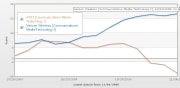
Perhaps even more telling, BrandIndex also measured how willing people said they were to recommend AT&T versus Verizon. In late October, the two companies were tied with scores of nine (on the same -100 to 100 point scale). By early November, Verizon had climbed up to 25, while AT&T had fallen to -8.

If all of that's not enough, the number of people reporting they're satisfied with AT&T has dropped in the past few weeks, too, according to BrandIndex's data -- while the satisfaction score for Verizon has remained constant.

"It's a pretty significant movement," says Ted Marzilli, global managing director of BrandIndex. "A fair number of people are believing or responding to Verizon's positive message, and they're also second guessing or altering their opinions of AT&T."

The effect could be a combination of the map-driven ads and the general buzz surrounding Verizon's launch of the Motorola Droid, Marzilli points out. And how long the impact will last, he says, is hard to gauge.

Regardless, it seems the majority of bloggers agree upon one thing: Whatever damage Verizon's ads may be doing, AT&T's flailing is only making it worse. The company could stand to take a lesson from a lifeguard: When you're drowning, the worst thing you can do is kick and scream. It only makes you sink faster.

++++

Verizon Mocks AT&T's Ad Lawsuit, Commenting "The Truth Hurts"

Jason Mick (Blog) - November 17, 2009 6:01 AM -- DAILY TECH

The nation's largest wireless provider fires back in court

AT&T and Verizon, the nation's second largest and largest telecoms, respectively, are at open war. With Verizon's new Droid phone looking to challenge the iPhone as the reigning media smartphone, the pair wage battle in the court room over Verizon's commercials which depict AT&T's poor 3G coverage.

It has been reported that in some areas, such as New York City, that AT&T's call drop rates are as high as 30 percent -- or that it merely has no 3G service at all. However, AT&T does have broad coverage under its older EDGE network, and it claims that Verizon's ads are deceptive. AT&T's argument basically boils down to a claim that the average viewer is fooled to believe that the Verizon commercial's maps represent total coverage and not 3G coverage -- despite several textual and audio clues. Thus it claims the commercials are misleading and damaging.

Initially AT&T only sued over Verizon's "There's a map for that" series, which introduced Verizon's rich red map and AT&T's lacking blue map to viewers, all while poking fun at Apple's iPhone slogan ("There's an app for that"). AT&T recently expanded the suit to include Verizon's new Christmas themed ads "The Island of Misfit Toys".

Verizon has flatly refused to stop airing the commercials, and to AT&T's dismay, the dispute seems unlikely to be resolved until well into the holiday season. AT&T had hoped to quickly get Verizon's ads pulled from TV.

In court this week Verizon filed new documents, according to Engadget, which blast its competitor, saying that the lawsuit is a weak attempt from a player that just can't compete. States Verizon's filing, "AT&T did not file this lawsuit because Verizon's "There's A Map For That" advertisements are untrue; AT&T sued because Verizon's ads are true and the truth hurts."

Continues the filing, "In the final analysis, AT&T seeks emergency relief because Verizon's side-by-side, apples-to-apples comparison of its own 3G coverage with AT&T's confirms what the marketplace has been saying for months: AT&T failed to invest adequately in the necessary infrastructure to expand its 3G coverage to support its growth in smartphone business and the usefulness of its service to smartphone users has suffered accordingly. AT&T may not like the message that the ads send, but this Court should reject its efforts to silence the messenger."

As it sees its hopes of a favorable court ruling in jeopardy, AT&T has tried to set the record straight among its own customers, writing them a letter asking them to ignore what it perceives as lies in Verizon's ads. It writes that the Verizon commercials are "so blatantly false and misleading, that we want to set the record straight about AT&T's wireless data coverage". In the letter, the company highlights what it sees as abundant mixed coverage on its older EDGE and new 3G networks.

Regardless of whether AT&T's dreams of silencing Verizon's commercials come true, evidence indicates that the damage has already been done. In recent weeks Verizon's brand image has soared while AT&T's has sank according to Apple Insider, according to recent BrandIndex surveys by YouGov. The surveys looked at whether customers would recommend the respective telecoms to their friends. AT&T scored less than a -2 in the most recent study -- indicating not many customers would recommend getting an AT&T phone.


The commercials seem to be working -- in recent months Verizon's image has soared, while AT&T's has sank, according to YouGov, which tracks brand reputation. (Source: Apple Insider)

++++

November 17, 2009 7:09 AM

Verizon Responds to AT&T Lawsuit: "The Truth Hurts"

Verizon mocks AT&T for whining in its response to lawsuit. Verizon's legal filing says "the truth hurts" and claims AT&T is simply trying to squash the marketing before the holidays. Tony Bradley

-- PC WORLD

Verizon has responded to the AT&T lawsuit over the "There's a Map for That" marketing campaign with a legal filing of its own. Verizon's message to the court and to AT&T essentially boils down to three words: "the truth hurts".

The Verizon legal team should be commended. Legal briefs and filings don't usually make very compelling reading, but this one is actually a pretty good read. It has a little drama, a little humor, and ultimately makes the point that AT&T is simply trying to use the courts to obscure the simple truth that its 3G network is inadequate.

In the filing, Verizon states "Remarkably, AT&T admits that the 3G coverage maps--the one thing that is common to all five ads--are accurate and that the ads' express statement that Verizon has "5X More 3G Coverage" than AT&T is true."

Verizon goes on to say "In the final analysis, AT&T seeks emergency relief because Verizon's side-by-side, apples-to-apples comparison of its own 3G coverage with AT&T's confirms what the marketplace has been saying for months: AT&T failed to invest adequately in the necessary infrastructure to expand its 3G coverage to support its growth in smartphone business and the usefulness of its service to smartphone users has suffered accordingly. AT&T may not like the message that the ads send, but this Court should reject its efforts to silence the messenger."

The legal response from Verizon concludes by saying "This motion is a blatant effort to ask the Court to do what the marketplace will not do: shield AT&T from truthful comparative advertisements that Verizon has a right to air and that consumers have a right to see."

Touché. Well-played, Verizon.

Recent reports from Brandindex.com show that Verizon's brand image is skyrocketing, while AT&T's has plummeted. AT&T could construe the reports to support its claim that the ads are misleading and damaging to its image.

Or, perhaps AT&T's claim has become a sort of self-fulfilling prophecy. By suing Verizon and making a big deal over the ad campaign, AT&T has increased the exposure of the ads exponentially. If the shift in brand perception is a result of the ads, it could be because they're true rather than because they're misleading. The fact that AT&T is whining about it publicly certainly doesn't improve its brand perception either.

AT&T was hoping to get an emergency injunction to force Verizon to pull the entire marketing campaign pending the results of a full hearing. It appears that AT&T will not get that injunction and that this case will not be heard for awhile. Even if AT&T ultimately prevails, the holidays will be over, the damage will be done, and Verizon will most likely have ended the campaign of its own volition anyway.

Verizon isn't making any claim in the ads that AT&T's own customers haven't already stated. Consumers have taken issue with AT&T's high dropped call rate in some areas, sparse 3G coverage, and more. I doubt AT&T will be taking its customers to court to get them to stop complaining.

AT&T is its own worst enemy in this case. It is drawing attention to disparaging details about its own network which it admits are accurate, and coming off looking like whiners at the same time. Seems like a lose-lose and makes me wonder if the AT&T legal team isn't secretly working for the Verizon marketing team.


Place BrandIndex research in Mediapost about QSR brand loyalty


Rising Loyalty Scores Good News For QSRs


burger king's $1 double cheeseburger

Adult perceptions of leading QSRs have been improving for the past year -- and the latest BrandIndex data show brand loyalty, in particular, rising dramatically during the past month.

BrandIndex tracks loyalty by asking consumers whether they would recommend a given brand to a friend.

The averaged "recommend" scores for McDonald's, Burger King, Wendy's, KFC, Subway, Pizza Hut, Domino's, Taco Bell, Long John Silver's, Hardee's, Chipotle and Jack in the Box (the 12 with the most units in the U.S.) jumped from 16.9 on Sept. 16 to 20.6 on Oct. 22. A score can range from -100 to +100, with zero indicating equal positive and negative feedback.

This rapid rise appears to have been driven in part by aggressive, post-Labor Day advertising focused on new menu items, such as Wendy's Bacon Deluxe, Burger King's $1 double cheeseburger, Taco Bell's Black Jack Taco and KFC's grilled chicken, says BrandIndex SVP and Global Managing Director Ted Marzilli.

However, he adds that willingness to recommend is typically indicative of behavior going forward. Furthermore, both the average "satisfaction" score and the average overall brand health scores for the 12 QSRs have risen from 19 on Jan. 1 to 25 as of Monday.

Loyalty and other scores are improving among the highest-income group (household income of $100,000 and over), along with those at lower levels, indicating that consumers who have traded down from casual and higher-end restaurants to QSRs "are finding themselves pleasantly surprised," Marzilli says. The chains' strategy of capitalizing on this trading down by introducing some higher-quality offerings -- such as coffee and premium burgers -- may be paying off, he surmises.

"This is really good news for the QSRs," Marzilli concludes. "Higher-end consumers may need a very compelling reason to trade back up once the economy starts coming back. If QSRs can hold onto some higher-end consumers, and the folks at the opposite end of the scale who have had to drop QSRs altogether return when jobs return, the chains will obviously be in an even stronger position" than before the recession.

BrandIndex surveys 5,000 adults from a sample that is representative of the U.S. population each day. The margin of error is +/- 2%.

BrandIndex's weekly Brandweek Buzz Report: Bank of America, Ford and SyFy


Bank of America Buzz Shows Negative Balance

Nov 6, 2009

Bank of America had a fairly good year in 2008, despite the economic downturn. But this year has proven to be much more different for the financial firm. According to market research firm YouGov's BrandIndex report, consumer-focused banks are averaging approximately -4 on its buzz score chart, but BofA has dropped from -15.9 on July 1 to -23.1 in Nov.

The Brandweek Buzz Report by YouGov is a weekly consumer perception report that analyzes the most talked about brands based on buzz: If you've heard anything about the brand in the last two weeks, was it positive or negative?

YouGov interviews 5,000 people each weekday from a representative U.S. population sample. Respondents are drawn from an online panel of 1.5 million individuals. A score can range from 100 to -100 and is compiled by subtracting negative feedback from positive. A zero score means equal positive and negative feedback.

This week, the report spotlights:

• Bank of America
• Ford
• Syfy


Bank of America Barely Moves the Needle
During the initial stages of the financial crisis in the fall of 2008, Bank of America was viewed as one of the industry’s more responsible players. This image was enhanced when it swooped in to purchase troubled firms Countrywide Financial and Merrill Lynch. But this year, BofA (and its former beleaguered CEO Ken Lewis) has become a preferred target for Congress and the media. The financial firm's troubles have lead to all negative numbers on YouGov's chart. BofA decided to change its image as the poster child for all things wrong, and launched a $40 million campaign devoid of financial lingo on Oct. 26. But it will take a lot more to convince consumers, given that the buzz needle has barely moved since the start of the campaign.


Ford Drives Forward
Unlike Bank of America, Ford is an example of a brand in a very troubled sector that was able to pull itself out of doldrums by doing all the right things. The automaker's quality perception chart stands out compared to the rest of the domestic carmakers from Jan. 1 through Nov. 3. It has indeed been a turnaround year for Ford. The Detroit carmaker refused to take TARP bailout money and rolled out appealing new models. Most recently, Ford tapped Dirty Jobs host Mike Rowe as the star of its “Why Ford, Why Now” integrated campaign. The company topped off its successes last week with a surprise third quarter profit of nearly $1 billion.


Syfy Rebranding Causes Confusion
No matter how you spell it, even though ratings have been solid, Syfy is confusing branding, particularly in the eyes of young men. With the intention of making the cable network more “balanced,” the NBC Universal unit introduced a new brand name that generated a lot of discussion, but seems to have confounded its core audience of young men. For men ages 18-34, the buzz score on July 6 was 29.8, the date the Syfy brand premiered with Warehouse 13. By Sept. 28, that score had taken a very steep drop down to 3.3. And as of Oct. 26, the score rebounded somewhat to 9.8. Despite the name fumble, Syfy is Top 10 across the board in terms of total viewers and demographics.

BrandIndex's coffee wars research in Ad Age article on Dunkin Donuts


Dunkin' Donuts Looks to New Executives to Keep Up Buzz

Seeking Fresh Perspective, C-Suite Changes Aim to Turn Focus to Operations

Mr. Travis, who previously ran Papa John's, has brought in Paul Twohig as brand operations officer, and John Costello as chief marketer. Mr. Twohig was previously with Starbucks, and has recently settled a lawsuit resulting from his hire, and Mr. Costello has held top marketing positions at Sears, Home Depot and Yahoo.

"The focus is going to be more on operations and the linkage with marketing," Mr. Travis said in an interview, about the changes to his C-suite. "I want to move this to be more of an operations-oriented company, which means several things. We need to provide our franchisees with all of the tools they need to run their business ... and we can ensure all of our operational standards are met."

Despite the sluggish economy, Mr. Travis said privately-held Dunkin' will open more locations than most competitors to grow sales. It's an impressive feat as Starbucks has continued to struggle, and once-surging Burger King has begun to slide. "Dunkin' has a lot going for them," Mr. Tristano said. "Strong brand loyalty, good marketing and advertising, and a good price point within the quick service [industry]. They're very poised to continue to grow through unit expansion and same-store sales."

Caffeinated brand
But competition has gotten much tougher and coffee consumption has been flat, according to Harry Blazer of the NPD Group. McDonald's launched McCafé in May, and even-lower-priced competitors like 7-Eleven have emerged. In terms of overall buzz, Dunkin remains well ahead of McDonald's and Starbucks, as measured by BrandIndex, with an average buzz rating in the 20s to low 30s, compared with a rating in the teens at McDonald's and the high single digits at Starbucks. And Dunkin' may have suffered less than some competitors as consumers cut back. An Experian Simmons survey of 25,000 adults said visits to Starbucks were down 4.5% for the year ended spring 2009, compared to a 1% drop for Dunkin' over the same period.